Friday, April 25, 2008

Practicing Pentecost: The Church Across the Color Line 2.0

Here's part 2 (of 3) of my interview with Jonathan Wilson-Hartgrove.


++++++++++++++++++++++++++++++++++++


Baldblogger (BB): In conjunction with your peacemaking efforts, you write that you and your wife had to “become black” to start to more fully understand your life at St. Johns’s and to more fully understand who Christ is. I wonder if you could briefly elaborate on this, and perhaps explain how this has influenced your understanding of the Bible and your own devotional habits. And a question for parents: besides embodying justice in terms of where you live and worship, and how you speak, how will you “teach” racial justice to your child(ren)?


Jonathan Wilson-Hartgrove (JWH): In the story that I tell, I try to take seriously James Cone’s claim that white people need to “become black.” Of course we can’t change the color of our skin, and the point isn’t to “act black” or “talk black.” Cone’s point is that just as Jesus was “numbered with the transgressors,” those who want to follow him in America today must be willing to bear the stigma of the oppressed. We aren’t called to “fight for the poor” as much as we’re called to join the struggle of those who are systematically excluded in our world.

All of our deepest convictions about who we are and what we want to be come out in parenting. My friend Amy Laura Hall has written about this in her book Conceiving Parenthood. For me, parenting is about continuing to learn the racial reality we live in. My son is black, so he has to face challenges that I did not have to face growing up. I don’t know enough to teach him all he needs to know. But that means I am dependent on others in the beloved community—black brothers and sisters who can teach him both how the world will hate him and how he can love his enemies. It always takes a village to raise a child, but Leah and I know we need our church and community in very real and practical ways.


BB: Your meditations on the practice of hospitality as it relates to your move into Walltown reminded me of the numerous conversations I’ve had with black friends and colleagues who are also committed to reconciliation. They surmise that race reconciliation is a noble goal, but that without economic justice, it is difficult if not impossible for what we might call collaborating for justice. In light of this, is there hope for those millions of Americans who live in suburban America? Or, perhaps are there other issues to deal with for those who do reconciliation work in the suburbs?


JWH: The suburbs are complex, and I don’t want to simplify them into the enclave of middle class success. That’s how we’ve idealized them in public discourse, but in most of our major U.S. cities, first ring suburbs are where the poorest of the poor now live.

But you’re right: reconciliation is always about economic justice. And economic justice is never just about “those people” fixing the system. It’s about all of us repenting of the ways we use some people so that others can be comfortable. You have to reckon with that whether you live in the suburbs, in the inner city, or on the farm.

Reconciliation is about setting out together with people who are not like you toward a way of life that is good for all of us.


BB: In Michael Eric Dyson’s newest book, April 4, 1968: Martin Luther King, Jr.’s Death and How it Changed America, he observes that King said that after the death of white privilege black equality would emerge (p.17). It seems that this is one part of what you argue in Free to Be Bound, stating more specifically that white encounters with various forms of “death” may bring new spiritual life. Is this a correct reading of your work—and can you respond to these thoughts?


JWH: King articulated this so clearly: the legacy of a slave economy is a pattern of life that depends on someone else to do the dirty work of the middle class. The Poor People’s Campaign was about saying to America, “We cannot live without our sanitation workers, our cooks and our farm workers. If we refuse to acknowledge the dignity of poor people, America will go to hell just as sure as the rich man, Dives.”

This is the message we as a country rejected when we killed King. But King’s willingness to die for this cause gives me great hope that the gospel does have the power to transform us even now. Beginning on the ground where we are, we can receive the gift of God’s love and make sacrifices for the sake of our neighbors, building the beloved community King dreamed of. We don’t need another King so much as we need an underground movement of little communities who live the subversive gospel under the radar, showing the world that another way is possible.


BB: Your chapter on connecting the history of racism with contemporary immigration concerns is just brilliant, and you offer a hefty criticism of multiculturalism and its discontents. You write: “Another way of saying this is that the language of multiculturalism makes it harder for the church to speak in tongues” (p. 181). I wonder if you could elaborate on this powerful thought—perhaps figuratively or metaphorically what it means for white Christians to speak in tongues?

JWH: Speaking in tongues, for me, is talking with people who aren’t like me. It means listening even when I don’t understand and trusting God for a miracle. It also means speaking when I’m not sure I’ll be understood.

Joe Biden got in trouble for calling Barak Obama “articulate” at the beginning of his presidential campaign. It’s not PC to say it, but Biden was just saying what multiculturalism assumes: black people are safe so long as they talk like white people. I worry about multiculturalism because it seems to reduce everyone to the common language of middle class values.

But that’s not what the Holy Spirit does. God makes it possible for us to understand and be understood by people who are not like us. Cone says white people need to “become black” in the sense that we need to identify with the oppressed. But I also have to admit that I’m always white, just as my black brothers and sisters are always black. By miracle, we can understand one another and live in community.

Sunday, April 20, 2008

Reviving the Great Awakening


Today's post features the first of a three-part blog interview with historian Tommy Kidd, associate professor of history at Baylor University. The recipient of numerous grants, teaching awards, and named in 2007 as a History News Network "Top Young Historian," Kidd's latest book is a synthetic treatment of the Great Awakening--a series of religious revivals during the eighteenth century--and is the main subject of this interview. We'll discuss scholarship, spirituality, and teaching.


The term great awakening itself has a rather long history--first used in the nineteenth century to describe the eighteenth century religious revivals--and has received recent press via Jim Wallis's latest book by the same title. The Great Awakening was an important moment in American religious history, and remains a salient topic of discussion and fruitful area of research, writing, and teaching.


Baldblogger (BB): For those unfamiliar with your work, or for first time visitors, if I may I’d like to begin with some autobiography. If you don’t mind, briefly trace your academic journey through your undergrad years and grad school. Any formative teachers? Why were they so influential?

Tommy Kidd (TK): I am a native South Carolinian, and received a B.A. in political science from Clemson University. During my undergraduate years, I became more interested in history, and decided to take a M.A. in history at Clemson. From there, I went to the Ph.D. program at Notre Dame, where I studied with George Marsden, who undoubtedly has had the most profound influence on my writing and intellectual development. Readers will note that The Great Awakening is dedicated to Marsden.

Marsden taught me that Christian perspectives in academia are not so “outrageous” (to use his term) as one might think, despite the secular bent of most major research universities. He also taught me that there is no point in writing history from a Christian perspective unless one first writes good history. In 2002 I joined the faculty at Baylor University.


BB: What inspired your interest in the history of Christianity—and evangelicalism in particular?

TK: As a practicing Christian, the Great Awakening--along with American religious history generally--holds obvious interest for me. I hardly think that Christian historians should relegate themselves to religious history, though. My own interests, for example, are shifting somewhat toward political history. But I also believe that the history of religion, and especially religious practice, is fascinating and has exercised deep influence in the forming of American culture.


BB: If it exists, what is a “typical” day for you at Baylor?

TK: On days that I teach, I typically spend most of the day in class, preparing for class, or grading. I try to reserve non-teaching days largely for research, especially in the morning. I typically spend several hours each of those mornings working on my current book project or revisions to a manuscript.

BB: Just for fun—if you were not a historian, what do you be doing?

TK: I’ve always thought I would love to be a color commentator for the Atlanta Braves. But unfortunately, as Jerry told George on Seinfeld, they usually get such announcers from within the baseball business!

Friday, April 18, 2008

Remembering Emmett Till, Again

Since I posted once about Emmett Till before, readers might be interested to read what's posted on one of my class blogs--Till researcher Devery Anderson has responsed to some of my students' questions about the Till case. Fascinating stuff, and it speaks to the continuing relevance, and witness, of Till's life.

Sunday, April 13, 2008

Practicing Pentecost: The Church Across the Color Line 1.0


This post begins a blog interview with Jonathan Wilson-Hartgrove about his fantastic and important book Free to Be Bound: Church Beyond the Color Line (NavPress, 2008). Thanks to Jonathan for his wilingness to particpate in this electronic conversation and dialogue.


I take the short title for this series of posts from Anthony Smith's chapter of the same title in An Emergent Manifesto of Hope and in recognition of teaching and inviting me to be part of the church beyond the color line.


Baldblogger (BB): A previous post introduced you to readers; we read some about your background, upbringing, and recent work and writing. Is there anything about your life and/or work you’d like to add? If you could, if it exists, what is a typical day at Rutba House and at St. John’s Missionary Baptist Church?

Jonathn Wilson-Hartgrove (JWH): Most important thing is that I’ve become a dad. Leah and I adopted our son, JaiMichael, who is now 3 and a half. He’s a joy—and a bundle of energy. If we ever had a typical day, we don’t any more.

At Rutba, we try to start and end the day with prayer together. In between, we do our work, answer the door, eat together, listen, and play. Most of these things get interrupted. But sometimes grace is in the interruptions.

BB: Now, a writing question. Your first book was published in 2005, and, impressively, you’ve published two more books within the span of a year and will have some more books published soon. When and where do you write, and from where does your inspiration come to write? In other words, any tips for good and effective writing? For interested readers, any projects in the works?

JWH: I write because I have to. I don’t know what I think until I see what I say, so I sort out my life in words. The incredible gift I receive from readers is that they consider it worth their time and money to think these things through with me. So I’m not alone. And, by grace, the bills get paid.

The challenge, then, isn’t so much to find the time to write as it is to remember all the other things that are important. Words are powerful, for sure. But we live in an information age that is flooded with disembodied words. Unless the word is made flesh, it rings hollow.

As I said, I write my questions. More and more, I’m writing the questions I live with others. For a few years now I’ve been in conversation about a new monastic movement in the contemporary church. My book New Monasticism: What It Has to Say to Today’s Church (Brazos) will be out next month.

Shane Claiborne and I have a book on prayer coming out this fall. We’ve been talking for years about the connection between action and contemplation, while praying and getting in the Way together. Becoming the Answer to Our Prayers (IVP) is a little meditation that invites others into that conversation. We’re just about finished, and it will be out this fall.

I’m starting to write about money. Jesus said you can’t serve God and Mammon, which sets up an interesting either/or. Sometimes we talk about “stewarding” money well. But on the whole, I think we have a hard time seeing money as a power here in the richest nation to ever exist. Prosperity gospel gets good air time in this country, but we don’t have much of an alternative. So I’m working on that right now.

BB: Specifically, what inspired you to write Free to Be Bound? The subtitle of your book of course brings to mind the famous phrase from Du Bois’s Souls of Black Folk (1903). Was it W.E.B. Du Bois specifically? Can you briefly explain the title of your book? It is catchy, punchy, yet deeply profound all at the same time.

JWH: I wrote Free to Be Bound because I needed to go deeper into the question I’d first asked at 16, when I met some black Christians—namely, why have I never met these brothers and sisters before? Following that question led me to join a black church, move into a predominantly African-American neighborhood, and, among other things, read Du Bois. He said the problem of the 20th century was the problem of the color line. My experience showed me that the color line was a dividing line in the body of Christ.

Forty years ago, the civil rights movement taught America that we’re bound to be free. This resulted in news laws liberating black people from second class citizenship. Forty years later, though, the question we have to ask is, “Free for what?” Christians have for the most part used our freedom to stay in race-based churches and pursue middle class success.

The good news of Jesus is that we’re free to be bound together in a beloved community where the rich are no longer rich and the poor are no longer poor because we all share our resources so that no one is in need. This book is about what it might mean to be that kind of community.


[Photo credit here.]

Friday, April 11, 2008

Something Funny for Friday


I guess these were the days before RateMyProfessor.com......


Monday, April 07, 2008

Du Bois in the Lone Star State 2.0


Last Thursday SDSU's Edward J. Blum gave a lecture/book talk at the University of Houston's Central Campus. The History and African American Studies departments co-sponsored the event. Thanks to Dr. Bob Buzzanco and Dr. James Conyers for making this event happen.

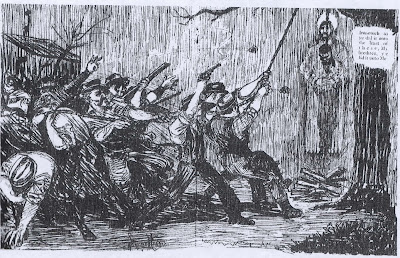
Ed's talk was titled "The Noose and the Cross: Race, Religion, and the Redemption of Violence in the Works of W. E. B. Du Bois," and discussed lynching and the way W.E.B. Du Bois worked to find redemptive value in this violent expression of white supremacy. Ed discusses this in great detail ch. 4 of his book W.E.B. Du Bois, American Prophet. (On a side note, the University of Pennsylvania Press has a unique deal for adopting Ed's book for your course--open access to the author who could conduct an email exchange about the book, conference call dialogue, or face-to-face interaction with your students.) The lecture also covered Du Bois's short stories, religious art from the Harlem Renaissance, Jeremiah Wright, and even religiously-themed artwork relating to the life of Tupac Shakur and Barack Obama (and here), among other topics.


Listen to the lecture here (53.5 MB). Ed used the image below--"Christmas in Georgia, A.D., 1916," by Lorenzo Harris, and taken from the December 1916 issue of The Crisis (pp. 78-79)--to begin the discussion. The caption reads: "Inasmuch as ye did unto the least of these, My brethren, ye did it unto Me."


As I remember it, these were the Q&A question topics (question are hard to hear on audio):

1) religion/hip-hop/"G" not gangsta but reference to "God/deity"

2) LeBron James/messianic images

3) Du Bois's use of religion for strategic, pragmatic purposes only

4) religious imagery/Nation of Islam/civil religion

5) Du Bois's "lost voice" prior to/during the Civil Rights Movement

6) Is Du Bois spiritual and/or religious? Neither? Religious not spiritual; spiritual, but not religious?

7) religiously-sanctioned violence (Christianity)

8) secularization and narratives of American religious history


Ed Blum, Baldblogger, and The Proletarian.


[Photographs courtesy of Caleb Alexander, African American Studies Department, U. of Houston.]

Friday, April 04, 2008

A Meditation on the "Ebony Disciple": Martin, Memphis, and Memory

Today is the 40th anniversary of MLK's assassination in Memphis, Tennessee.

I haven't really spent time canvassing the Internet in search of stories, but Ed Gilbreath offers his usual insightful commentary about contemporary affairs--in this case MLK--here.

A few weeks back I began to make my way through Michael Eric Dyson's latest book: April 4, 1968: Martin Luther King, Jr.'s, Death and How it Changed America. Dyson will discuss this book on C-SPAN2's Book TV live on Sunday, April 6.

Dyson examines the end of King's life, offers a literary analysis of his sermons, and discusses black America 40 years after King's death. Dyson also address black leadership in the wake of King's death, with chapters on Jesse Jackson, Al Sharpton, and Barack Obama--and most interesting of all takes creative license to write an Afterword titled "Interview with Dr. King on His 80th Birthday." It is the most intriguing part of the book. [UPDATE: Ed Gilbreath informs me that this interview is available over at The Root.]

Here’s a memorable King quote, whom Dyson calls Jesus’s “ebony disciple,” full of prophetic insight and admonishing encouragement: “I wish today, that Christians would stop talking so much about religion, and start doing something about it, and we would have a much better world. But the problem is that the church has sanctioned every evil in the world. Whether it’s racism, or whether it’s the evils of monopoly-capitalism, or whether it’s the evils of militarism. And this is why these things continue to exist in the world today” (pp. 126-27).


[Photo credit here.]

Tuesday, April 01, 2008

Du Bois in the Lone Star State


And find out more about the lecture here.

Friday, March 21, 2008

What's In Store: The Spiritual Marketplace


Readers of baldblogging may remember previous posts about various issues dealing with today's spiritual marketplace. I've commented about it in the context of my teaching, documentaries, the installation of a Cardinal, recent scholarship (here too), and religious celebrity (be sure to read this scholar's work on religious celebrity and keep an eye open for her forthcoming work on the religious celebrity of Oprah). Darren Grem has some keen thoughts on the topic as well, in addition to what looks like a great dissertation on related subjects.


Well, I'm happy to announce another "offering" on the subject--a book titled Holy Mavericks: Evangelical Innovators and the Spiritual Marketplace. Co-authored with friend and comrade Shayne Lee, a sociologist at Tulane University and author of T.D. Jakes: America's New Preacher, New York University Press will publish Holy Mavericks in 2009.

Holy Mavericks uses the theory of religious economy to study contemporary religious trends in the United States. It imagines this country as a spiritual marketplace where religious firms offer spiritual goods and services to religious consumers.

The result of nearly three years of research and extensive participant-observation in Connecticut, Florida, California, Georgia, and Texas, our project explores the extraordinary appeal of five evangelicals who make strong cases to replace Billy Graham as America’s leading preacher and evangelist: Paula White, T.D. Jakes, Rick Warren, Joel Osteen, and Brian McLaren. They pastor some the largest churches in the nation, lead vast spiritual networks, and are among the most influential preachers in American Protestantism.

They write best-selling books and draw thousands of people to their conferences. They are fixtures on the airwaves, appearing as special guests on television programs. Newspapers report on their vast influence. Thousands of websites, blogs, and chat rooms dispatch their names throughout cyberspace, both praising and chastising their ministries.

Through the power of their appeal, rather than the authority of ecclesiastical positioning, they assemble multi-million dollar ministries and worldwide renown. With weak or no denominational ties, they are free agents who make their mark on contemporary American society.

When the time comes, get your copy here.

[Photo credits here, here, here, here, and here.]

Thursday, March 20, 2008

For Those With Eyes to See and Ears to Hear

Svend Akram White, who blogs over at Akram's Razor, recently published this article on responses to Barack Obama's recent speech. Thanks, Svend, for prophetic clarity in these times of fog and haze.

Scholar Jon Pahl also has some insightful points--a Holy Week meditation on the Rev. Jeremiah Wright, and Ed Blum muses about prophets and politicians here.

Wednesday, March 19, 2008

God's Time

God's Time

"I've only just a minute,
Only sixty seconds in it.
Forced upon me, can't refuse it,
Didn't seek it, didn't choose it,
But it's up to me to use it.
I must suffer if I lose it,
Give an account if I abuse it,
Just a tiny little minute,
But eternity is in it."

Dr. Benjamin Elijah Mays
(Be sure to check out Randal Jelks's forthcoming book on Mays. Click here to watch Jelks's February 19, 2008, lecture on Mays at the U. of Kansas. You may have to scroll down to find it.)

Knight is Right, Too


In the previous post I argued that the Rev. Jeremiah Wright's denunciations of white power and white Christianity were right. In this post, I suggest that some of what Steve Knight observes about the Wright/Obama controversy is right on as well.


Steve blogs over at Knightopia and routinely has insightful posts and keen insight into the complexities of faith and culture. He is the co-founder and co-organizer of the Emergent Cohort in Charlotte, NC. Steve also arranged things for Brian McLaren's stop in Charlotte for his Everything Must Change tour.

On Monday, March 17, Steve and Anthony Smith (a.k.a. the "Postmodern Negro") taped a conversation--in the context of the Wright/Obama controversy--about the implicit whiteness that shapes and forms North American evangelical theology on the one hand, and on the other the imperative for white Christians to read deeply in black theology and literature and culture to understand, for example, why the Rev. Wright said what he said, and made the claims he made. Smith discusses key elements of how many African Americans see the church and the world and explains what an Afrocentric theology actually looks like. Knight discusses white privilege and how it plays out in politics and in the church, and suggests that white folks own up to the history of privilege, what it looks like today, and why a deconstruction of it matters. There's also a discussion of the black Jesus. These are simply a few highlights of the conversation; the entire discussion deserves a good listening.


In sum, Knight offers these thoughts: "The bottom line is: White Christians need to work harder to understand the history and complexity of the black church tradition and the role of prophetic voices (like Rev. Jeremiah Wright)."


I couldn't agree more. Like Wright, Knight is right.


[Update: read the text and watch Obama's Philadelphia "race" speech here, and check out Obama's discussion on the Tuesday episode of ABC's Nightline. Ed Gilbreath offers up some good commentary, as usual.]

[Photo credits here and here.]

Tuesday, March 18, 2008

Wright is Right


"The whites have always been an unjust, jealous, unmerciful, avaricious and blood-thirsty set of beings, always seeking after power and authority."


The Internet is abuzz with stories, columns, and musings about the Rev. Jeremiah Wright's comments regarding the United States and 9/11, as well as his criticism of white America in the context of his support of Barack Obama. Some pundits are even calling the seasoned pastor and prophetic cleric a racist.


Denial and amnesia are unfortunate, and today seem to afflict the rich and the powerful. Truth telling and prophetic witnessing, yet again, scream from the margins. For those with ears to hear, and with eyes to see....

All of this is interesting in light of the attention Jeremiah Wright's jeremiads have gotten. Some of the saner, more illuminating posts on Wright come from historians Ralph Luker and Ed Blum (HT: Paul Harvey) and religious studies scholar Jonathan Walton. Diana Butler Bass also offers important thoughts over at God's Politics. Anthony Smith weighs in here, and antiracist activist Tim Wise clarifies matters, too. Jim Wallis crafts a customary illuminating response here, and Adam Taylor discusses the context of prophetic preaching here. And Ed Gilbreath muses about events here and here.

Wright's criticism of America--and indeed criticism of white America and white Christianity--not only took place in the context of a black church, but also is part of a long history of prophetic utterance and righteous indignation. Wright spoke the truth--and he did it with rage, and screaming, and with what we might call a performative utterance--but he spoke the truth that many still refuse to hear. And, the Christian church possesses the concepts and categories to work toward reconciliation, and this is one of the aims of Wright's church. Reconciliation can't come about without truth-telling, and truth-speaking--and truth-seeking.

Do you remember.....Richard Allen, Sojourner Truth, Frederick Douglass, David Walker, W.E.B. Du Bois, Ida B. Wells, Vernon Johns, Martin Luther King, Jr., Fred Shuttlesworth, James Baldwin, etc.? The list goes on and on.


Luker and Blum trace out the history of these folks, and Bass adds key thoughts to the retelling of this story (and Wise is his usual contrarian, prophetic self), but I would like to highlight the work of David Walker, a free black man deeply involved in the abolitionist movement and who worked in Boston at a second hand clothing store in the early 19th century. Famously, he published in 1829 An Appeal to the Coloured Citizens of the World and shipped the pamphlet South. Word spread about Walker's Appeal, and it is to this document I appeal in 2008. It is simply one part of the history about which Luker, Blum, and others offer reflections.

Like Rev. Wright, Walker spoke in the context of the prophetic Christian tradition.

Here is Walker:
"Are we MEN! ! -- I ask you, 0 my brethren I are we MEN? Did our Creator make us to be slaves to dust and ashes like ourselves? Are they not dying worms as well as we? Have they not to make their appearance before the tribunal of Heaven, to answer for the deeds done in the body, as well as we? Have we any other Master but Jesus Christ alone? Is he not their Master as well as ours? -- What right then, have we to obey and call any other Master, but Himself? How we could be so submissive to a gang of men, whom we cannot tell whether they are as good as ourselves or not, I never could conceive. However, this is shut up with the Lord, and we cannot precisely tell -- but I declare, we judge men by their works....The whites have always been an unjust, jealous, unmerciful, avaricious and blood-thirsty set of beings, always seeking after power and authority."

Jesus said that you can judge a tree by its fruit.

Walker continues: "Let no man of us budge one step, and let slave-holders come to beat us from our country. America is more our country, than it is the whites-we have enriched it with our blood and tears. The greatest riches in all America have arisen from our blood and tears: -- and will they drive us from our property and homes, which we have earned with our blood? They must look sharp or this very thing will bring swift destruction upon them. The Americans have got so fat on our blood and groans, that they have almost forgotten the God of armies...."

And finally:
"What nation under heaven, will be able to do any thing with us, unless God gives us up into its hand? But Americans. I declare to you, while you keep us and our children in bondage, and treat us like brutes, to make us support you and your families, we cannot be your friends. You do not look for it do you? Treat us then like men, and we will be your friends. And there is not a doubt in my mind, but that the whole of the past will be sunk into oblivion, and we yet, under God, will become a united and happy people. The whites may say it is impossible, but remember that nothing is impossible with God."

Indeed, nothing is impossible with God.

Read more from Walker's Appeal here.


And on a final note.....I don't remember where I read or heard this [Update: found it.], but I can't recall seeing or hearing anyone denouncing the inflammatory statements made by San Antonio minister the Rev. John Hagee, the fiery parson who recently endorsed John McCain. Hagee has thrown his full support behind the nation of Israel, and recently called for a U.S. invasion of Iran.


Once again, Wright is right.


[Photo credits here and here.]

Friday, February 29, 2008

The Unveiling: Free to Be Bound


Author, pastor, activist, and thinker and Rutba House member Jonathan Wilson-Hartgrove is the subject of a series of forthcoming posts. I first heard of Jonathan in 2005 when I came across his book about peacemaking in Iraq, and have seen his name in various places and have read his work ever since.


I was intrigued and interested when in early February I received word of his latest offering: Free to Be Bound: Church Across the Color Line.

Jonathan's work is not a "how-to" manual for race reconciliation, but an honest and open examination, exploration and critique of white privilege and white supremacy. He tells stories, sings and feels the blues, interprets the scriptures from refreshing and challenging angles, and offers his thoughts on the radical life that death can bring.

Part-memoir, part-manifesto, part-confession, and wholly prophetic, I read it last week, underlined a good portion of the book, made tons of comments and observations, and have a whole slew of questions. This book is quite important, controversial, well-written, readable, and worthy of much discussion and reflection.

I hope you will join us in the coming weeks as I interview Jonathan here at bald blogger. Pick up a copy of Free to Be Bound and leave your thoughts, comments, questions, and observations.

You may also want to check out some interviews with Jonathan and other assorted links here, here, here, here, here, here, and here.
[Photo credit here.]

Monday, February 18, 2008

In Class with The Professor: W.E.B. Du Bois Teaching Workshop


In collaboration with Ed Blum and Eddie Carson, I will co-lead a teaching seminar on W.E.B. Du Bois in early April. I'm thrilled to be working alongside two wonderful people, two fine teachers, and two great friends.


Ed is coming to the University of Houston for a book talk (get your copy of Ed's book here) and we've put together a companion workshop for high school teachers, graduate students, and university faculty.


Hope you can make it. Check out the workshop website here.


I will podcast Ed's UH lecture and we'll probably record the teaching seminar as well. Look for links in future posts.


[Photo credit here.]

Sunday, January 20, 2008

A King for Our Times


Around this time every year, as with many, King is on the mind. For many years the "I have a dream" mantra has dotted the airwaves and enveloped the history classroom. I sought to try to begin changing that a few years ago--at least in my classroom.

My students had already memorized a good part of the "dream" speech in their literature classes, so I introduced them first to the King who had a doctorate in theology. I then introduced a King who won the Nobel Peace Prize in 1964 by having students read the speech. Discussions were interesting. This assignment preceded my reading of a few paragraphs of King's 1967 Vietnam War speech. The prophet was speaking, and speaking loudly and clearly, and he suffered for it.

Who is King for our times? A radical King, a prophetic King.

Harvard Sitkoff, a historian at the University of New Hampshire, just published a new biography that recollects--or resurrects--a radical and religious King who saw as part of the call to justice economic equality and antiwar activism.

And how is King remembered by some? Historian Andrew Manis published a short piece in 2005 titled "White America and the MLK Holiday." It is a penetrating article, and deserves to be read and re-read every January if not more frequently. A sampling of lines: "White America loves the colorblind King of 1963, but we studiously avoid the more radical King of 1968," and "King's birthday is a wonderful opportunity for the majority of white Americans to awake from our dreamworld."


While King's "I Have a Dream" speech is a profound and important oration, let us not forget his equally powerful and prophetic musings from the late 1960s.

It is here we may find a King for our times.

[Photo credit here.]

Tuesday, December 25, 2007

Christmas with Du Bois, ca. 1909-10


O Thou Incarnate Word of God to man, make us this Christmas night to realize Thy truth; We are not Christians because we profess Thy name and celebrate the ceremonies and idly reiterate the prayers of the church, but only in so far as we really comprehend and follow the Christ spirit- we must be poor and not rich, meek and not proud, merciful and not oppressors, peaceful and not warlike or quarrelsome. For the sake of the righteousness of our cause we must bow to persecution and reviling, and again and again turn the stricken cheek to the striker; and above all the cause of our neighbor must be to us dearer than our own cause. This is Christianity. God help us all to be Christians. Amen.

Luke 2:8-14


Christmas


--from W.E.B. Du Bois, Prayers for Dark People, ed. Herbert Aptheker (U. of Mass. Press, 1980), p. 63


[Photo credit here.]

Friday, December 21, 2007

"For unto us a child was born...in Harlem...in 1924...."


As this time of year is the season of birth(s) and beginnings, what some call Advent, or an all-out capitalist bonanza at the store of your choice, it is also a time to remember a death--the 20-year commemoration of the passing of James Baldwin.

Readers of this blog are already aware of my affection for St. James.

Democracy Now recently devoted part of a show to Baldwin's legacy, interviewing his sister-in-law Carole Weinstein as well as actor Calvin Levels, who is performing a one-man-show of James Baldwin called "James Baldwin: Down From the Mountaintop." Hopefully it will come to Houston. (Read a review here.)

As I reflect on the life of St. James, particularly during the Advent season, I'm drawn to the hope--critical, exacting, honest, and yes, prophetic--resident in Baldwin's writing, his plays, his speaking, and above all the hope evidenced by his living. And, in a sense, Baldwin's words, whether written or spoken, seem to never return void.

So take time during the holiday season to read something of Jimmy's--The Fire Next Time, Another Country, Nobody Knows My Name, or anything else that comes to mind. Share your reflections and thoughts--gift someone with Baldwin during the holidays.

Or, you can following Baldwin on-line. Watch a C-SPAN special here. Visit the blog of Professor Zero who has a page of Baldwin links. For those more familiar with Baldwin's work, there's tons to read here, or here. Or, read Baldwin quotes with links to other great sites.

Finally, artist Claire Burch has created some wonderfully stunning artwork with Baldwin as its subject, shares articles and letters, and offers poetic reflections on St. James as well--ironically titled "Arrival of James Baldwin; Mysterious Circumstances."

This is Advent with St. James.

[Photo credit here.]

Thursday, November 29, 2007

Merry Chri$tma$ with Rev. Billy


If you've seen Super Size Me, then you will want to go see this documentary. It opens at the River Oaks theatre in Houston on Dec. 7. Check it out. Read some reviews of the film here.


[Photo credit here.]

Friday, November 23, 2007

No Holiday for the Spiritual Marketplace: Religious Celebrities in H-Town


The elevation of Houston Archbishop Daniel DiNardo to the position of Cardinal this weekend has me thinking of religious celebrities.


CBS affiliate KHOU has a newstory here that features an interview with DiNardo's sister, a Houston resident. See DiNardo's Houston-Galveston Archdiocese bio here, newstories from Pittsburgh, the priest's old stomping grounds (read here also). Houston Chronicle religion reporter Tara Dooley blogs about DiNardo here, and writes about DiNardo here.

Some of my current research deals broadly with this topic, and it is interesting to note that Houston--the nation's 4th largest city--is quickly becoming a haven for religious celebrities. If we consider Texas more broadly--we might as well call it the Lone Star Spiritual Marketplace. Perhaps I'll compose another blogpost on the state later on, but in the meantime read Roy Spence's The Amazing Faith of Texas. Check out the book's website here.

If you know Houston, the first religious celebrity that comes to mind is probably Joel Osteen. There are other Protestant and Catholic religious celebrities, as well as prominent folks from other faith traditions.

These figures may or may not embrace the title "religious celebrity," but today's hyper-capitalist society influences and informs the performative aspects of just about everything. Plus, the separation of church and state, dating back to the 1790s, first created the possibility for a religious or spiritual marketplace.

Scholars have written about religious celebrity (read about Dr. Phil here, and Mother Theresa here, for example), and one of the people to read on this topic is Kathryn Lofton--whose own work deals with Oprah and spirituality. Read here, here, and here, too.

So, since there's no holiday for America's spiritual marketplace, pardon the pun, feel free to leave your $.02 worth about the topic. Also, who are some other religious celebrities in Houston, or Texas more broadly?

[Photo credit here.]